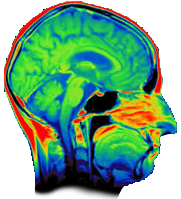
Magnetic Resonance Imaging (MRI)
We offer these examinations at the following locations.




Magnetic resonance imaging is a modern imaging technique that can produce cross-sectional images of almost all body regions.
What is MRI?
Magnetic Resonance Imaging (MRI), also called nuclear magnetic resonance imaging, is a state-of-the-art cross-sectional imaging technique that uses magnetic fields and radio waves instead of X-rays to create images. Since nearly all body tissues contain hydrogen atoms, and these atoms have a magnetic moment due to their spin, they align in a strong external magnetic field. When a strong radio signal is applied, the hydrogen atoms begin to oscillate, and if the correct frequency is used, they resonate—this is magnetic resonance. The emitted radio signal can then be measured from outside like an echo. Through complex sequences of excitation and measurement, a high-performance computer converts these signals into cross-sectional images. Both two- and three-dimensional images can be produced. Special imaging techniques can highlight structures such as blood vessels (MR angiography) or bile ducts (MR cholangiography) without contrast agents. Certain tissue types, such as joint cartilage or fat, can be emphasized or suppressed. Recent developments allow assessment of brain activity (functional MRI) or chemical tissue analysis at any body location (MR spectroscopy). The core of the MRI system is the magnet, which forms the “tunnel.” Similar to a CT scan, the patient lies on a table and is moved into the magnet tunnel to examine the relevant body region. Specially shaped coils, for example for the head, spine, joints, or breast (MR mammography), are placed directly on the area being imaged.
During the examination, you will hear varying levels of humming and knocking sounds, but these are not bothersome when wearing ear protection.
For certain examinations, it may be necessary to inject a contrast agent into a vein in your arm. The examining physician will discuss with you beforehand whether this is required. The contrast agent (gadolinium) is generally well tolerated and very rarely causes side effects. It is not radioactive, spreads quickly through the bloodstream, and is completely excreted by the kidneys.
What should I, as a patient, keep in mind?
No special preparations are required. Shortly before the examination, all metal objects must be removed, such as jewelry, watches, clothing with zippers or metal buttons, removable dental work, and similar items, as metal objects can both affect image quality and be attracted by the strong magnetic field.
Credit cards with magnetic strips and loose metal items such as money and keys must also not be brought into the examination room. If you have metal objects in your body, such as implants, please inform the staff beforehand. For this reason, patients with a pacemaker or most cochlear implants, for example, cannot undergo the examination.
Patients with claustrophobia can usually be examined successfully after receiving appropriate sedatives. If you have ever experienced claustrophobia, please inform our staff before the examination and bring a companion with you. If a sedative is administered, you must not engage in any activities requiring alertness that day, especially driving a vehicle yourself.
Please also inform our staff—if known—about any existing kidney problems, allergies, or any previous adverse reactions to contrast agents.